
Paul Nordberg
My activities & loves
Paul Nordberg
My activities & loves
The records and illustrations here cover some of the more common macrofungi – mostly mushrooms – of Ipswich, Essex County and the surrounding North Shore of Massachusetts. The list does not pretend to be comprehensive or authoritative. Rather, like its sister page on lichens, it reflects the ongoing efforts of an amateur to learn about a different form of life.
I expect to revise early entries as my knowlege grows and I discover the need for corrections and clarifications.
The dates shown reflect the time of field observation, not of posting here.
I deliberately do not address edibility or toxicity here.
I welcome comments and questions.

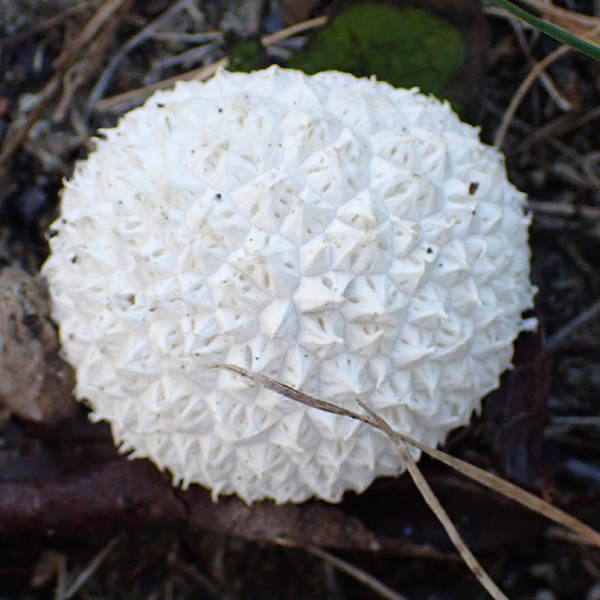
This specimen of peeling puffball (Lycoperdon marginatum) offered a very unusual instance of being able to identify a mushroom on the basis of a single picture and bare-bones information about where it was found. Its shell with white pyramids is striking.
Wikipedia offers an excellent overview of this species and its habitat.
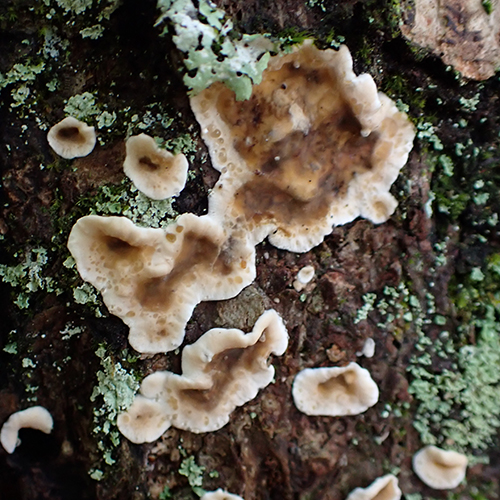
Smooth patch disease (Aleurodiscus oakesii) is a widespread crust fungus. "Crust" is a good description, and the "oakesii" part of the scientific name gives a good hint about what kind of trees it likes to grow on.
"Disease?" I have found different takes on that. Most reports are that the fungus colonizes the bark, but not the wood of the tree, sometimes creating a "smooth patch" but creating no deep harm. That calls to mind diseases of the human skin, which are often disfiguring but not necessarily harmful beyond that.
I have seen A. oakesii on completely dead and bare white oak, along with growths on the sparse areas with remaining bark. Perhaps living oak wood is not affected?
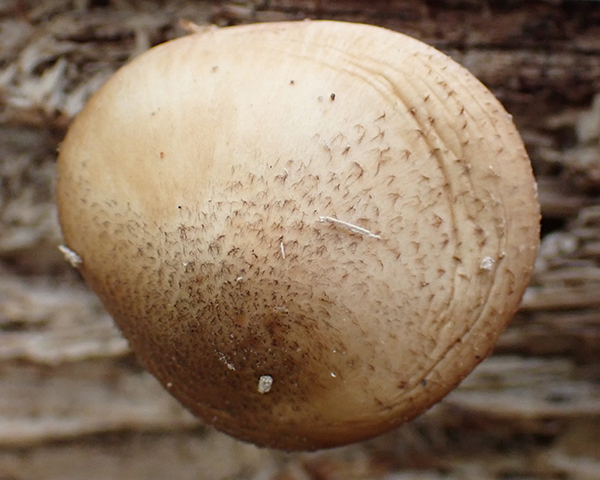
This a a member of the bewildering group of "Little Brown Mushrooms." Of the possibilities I have considered, it is most consistent with the description of the deer mushroom (Pluteus cervinus), which Baroni notes is widespread in this area.
In other aspects, my specimen fits with his description: growing on a fallen tree trunk, light brown spore print, body unremarkable buff, gills free.
There is probably variability within the canonical taxon, and of course other taxa could fit. For now, I am following the maxim, "If you hear hoofbeats, think horses, not zebras."
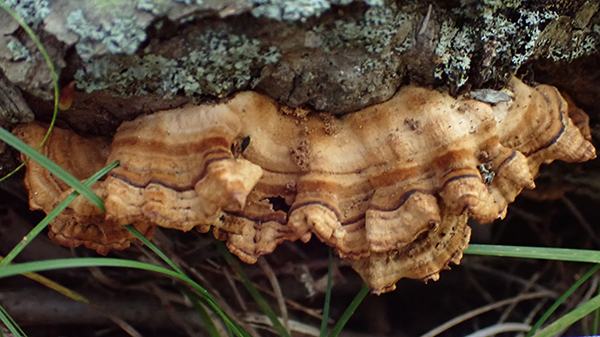
This fungus is eye-catching with its colored stripes and ruffled edges. It is a crust fungus, without the gills or pores "mushrooms" have to release their spores. Its underside, reflecting this characteristic, is smooth, unlike that of the "true" turkey tails. So, this one is "false."
To complicate matters, the taxonomy of the group is unsettled. I am referring to it as a member of the false turkey tail group (Stereum hirsutum complex). The class also sometimes goes by the name of Stereum ostrea.
"A rose by any other name…"
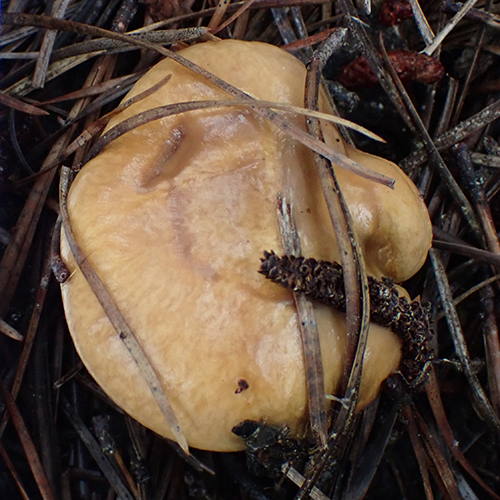
Slippery Jack's cousin, slippery Jill (Suillus salmonicolor), shows a clear family resemblance. The color of this specimen is salmon, as its scientific name indicates. In other examples, it is more brown. The circumscription of the taxon has evolved; it was formerly known as S. luteus.
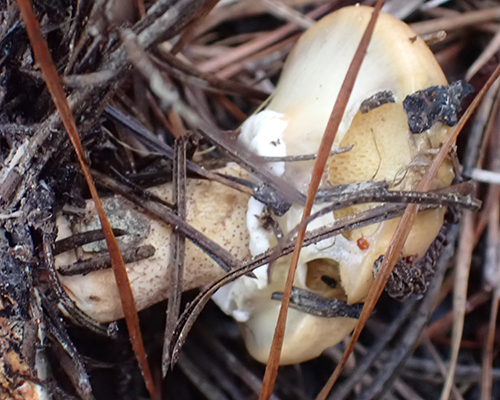
Baroni notes its cottony ring, "producing a distinctive roll on the bottom of the veil." He also notes that its habitat is often sandy soil under pines such as pitch pines. Those traits fit this specimen perfectly.
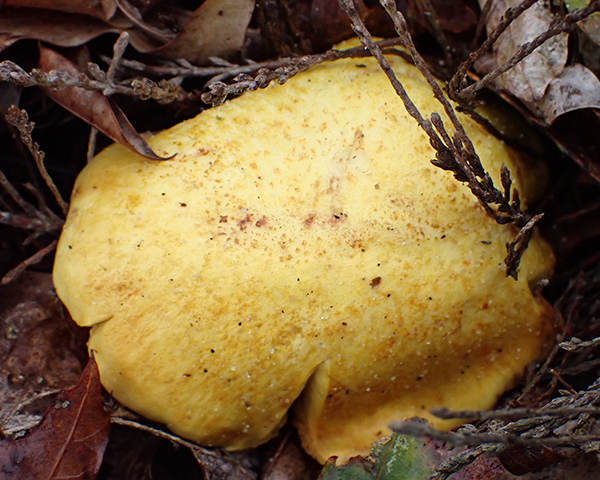
I am beginning to sort my way through mushrooms of the genus Suillus, an intriguing but challenging group. They may have eye-catching colors, like this specimen. Their surface is described as "slimy" or "sticky" or "viscous." That makes them a little tricky to pick up and prone to acquire dirt and debris.
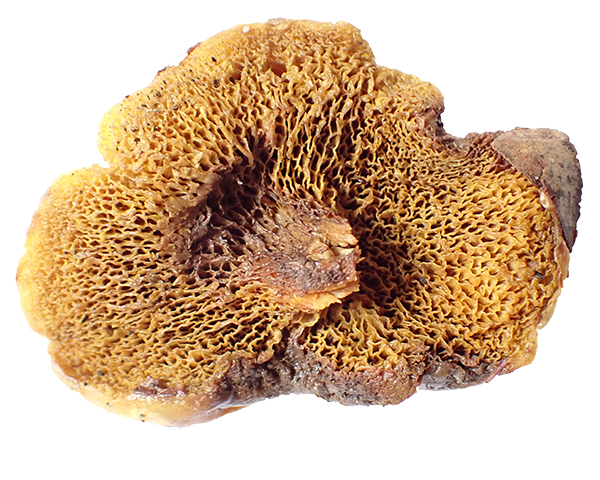
They have pores rather than gills on their lower surface, which tends to be fragile. The picture here is of a specimen in fairly good, very ripe condition. It it is difficult to get good spore prints from them.
I am feeling comfortable at this point in identifying two species, a Jack and a Jill, with others to be resolved. This one is American slippery Jack (Suillus americanus), identifiable by its proximity to eastern white pines, the only tree it forms relationships with. I had to go back and make sure the pines were these, rather than the much more common pitch pines of this area. Indeed, the needles were in clusters of five rather than three, indicating the former variety rather than the latter.
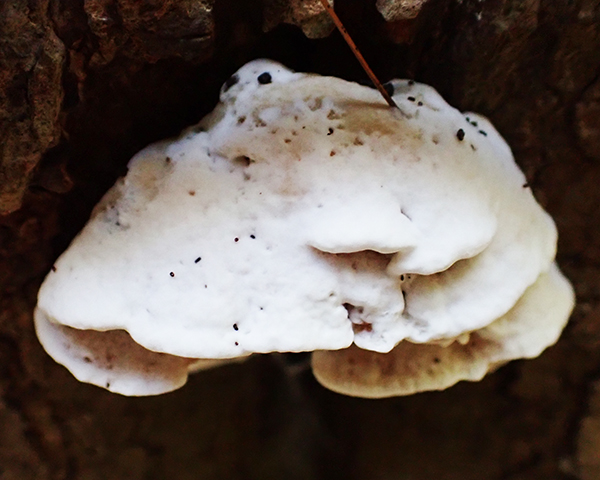
As mushroom names go, white cheese polypore (Tyromyces chioneus) is reasonably fit. It is white and a bit soft to the touch, rather rubbery. Cheese? – Well, it does look a bit like mozzarella beginning to melt.

The underside has many, many pores, just as the name poly + pore indicates.

I have spent over two weeks scratching my head about this specimen. It fits nicely with Baroni's description of Leccinum versipelle, except for the critical difference that that species is by all accounts associated with birch trees, while mine was clearly under an oak.
After research and digestion, I believe it is most likely Leccinum aurantiacum, commonly called red-capped scaber stalk, or according to unsourced Google reports, sometimes orange oak bolete. Bessette is more permissive on habitat than Baroni, reporting "mixed hardwoods and conifer forests" rather than "under poplar or aspen and pine."
It is a fat, stubby presence. Note the black knobs, "scabers," on the stem.
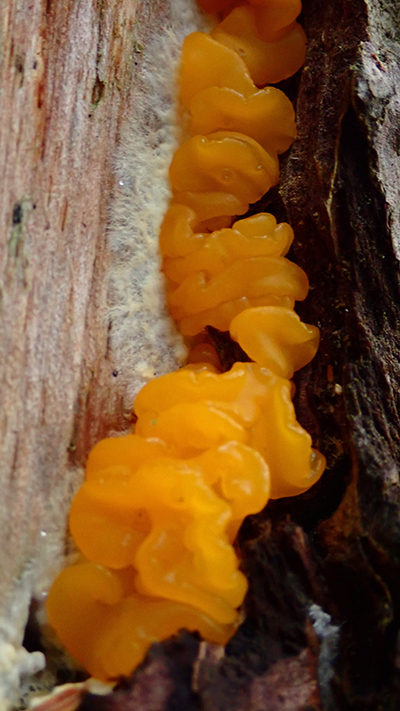
The morning after the posting below of witches' butter (Tremella mesenterica), my eyes were attuned and I noticed Dacrymyces chrysospermus, sometimes called orange jelly spot or orange witches' butter. It was growing on a dead hemlock, rather than a hardwood, so I was immediately able to identify it as distinct.
The similarity of the two species is remarkable. They are several branches away on the taxonomic tree, yet are the only groups with such an appearance. D. chrysospermus is perhaps a little more orange, as its name indicates.
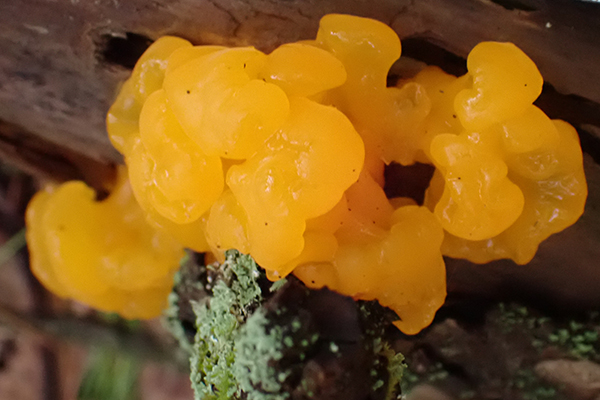
The bright yellow presence of witches' butter (Tremella mesenterica) in deep shade is eye-catching. Mycologists usually include it in their inventories as a jelly fungus. It obviously doesn't fit the common mental image of "mushroom."
Orange jelly spot (Dacrymyces chrysospermus) is a close look-alike that grows on conifers, while T. mesenterica grows on hardwoods. I was unable to distinguish what kind of wood my specimen was growing on, since its condition was too far gone; but there were no conifers in the vicinity.
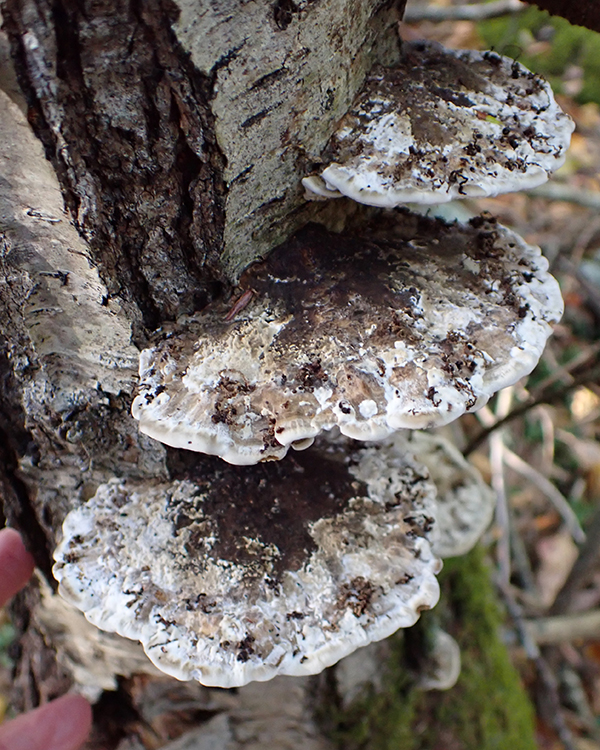
This growth certainly has a time-worn appearance, a variable patina from years of bumps and exposure, somewhat in the fashion of brass submerged in the sea. I have come to like it. It does make identification, from the top side alone at least, problematic.
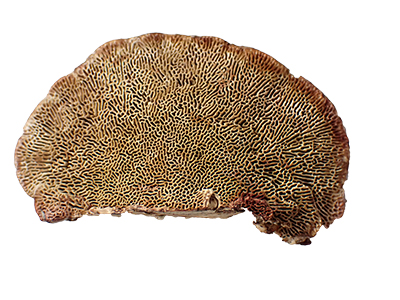
But its underside readily marks it as blushing bracket, or thin-walled maze, polypore (Daedaleopsis confragosa). Looked at closely, the lower face is a labyrinth of pores, like the one Daedalus of Greek mythology created to imprison the minotaur.
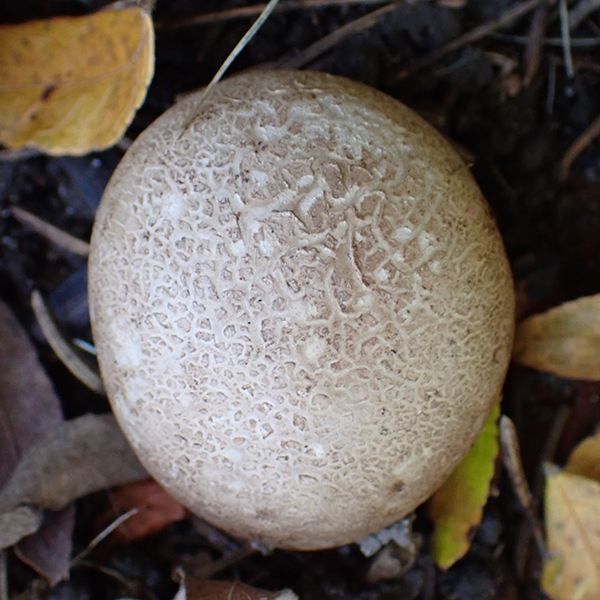
I find more joy in recognizing something new close to home than in sightseeing in faraway places. This common earthball (Scleroderma citrinum) is one of a cluster growing in the joints between paving bricks next to my garage, not a hundred feet away from where I am now.
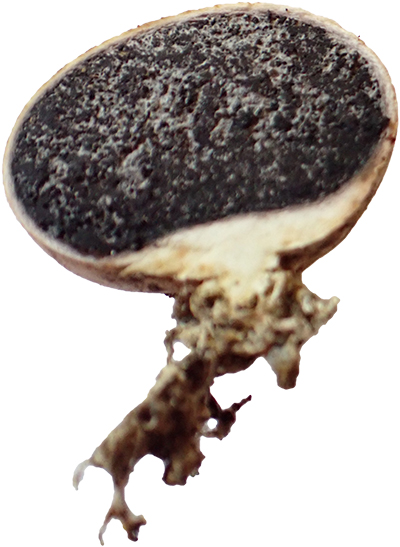
A section through the growth shows the dark interior mass that contains the spores.

Orange mycena (Mycena leaiana) is a small but bright orange mushroom, readily visible even in deep shade. Clusters of it on rotting logs are common.
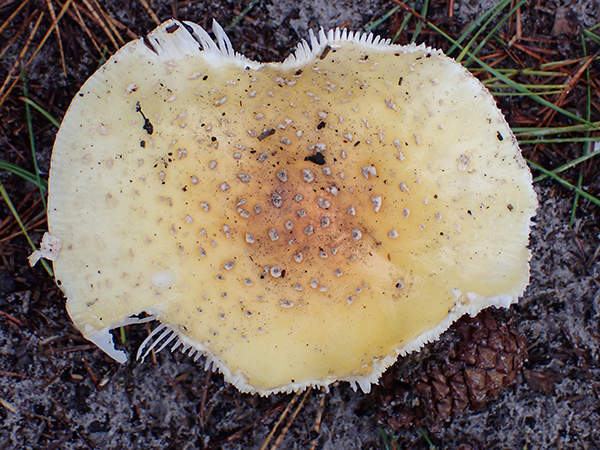
I have spent some extra time and effort on this mushroom. I believe that it is reasonable to identify it as yellow-orange fly agaric (Amanita muscaria var. guessowii). I show it in an older, somewhat past prime example; and in an early, budding phase.
Rationale: its appearance suggests that it is somewhere within the genus Amanita.
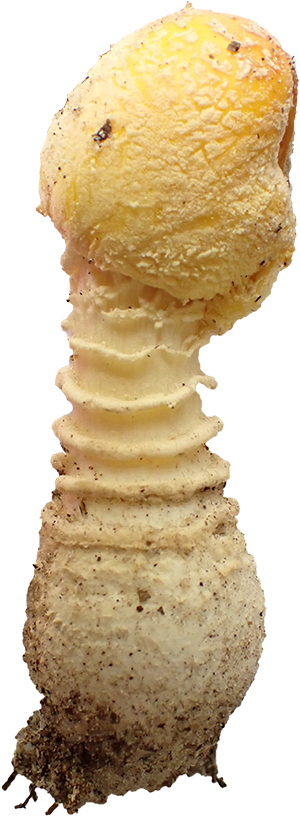
Beyond that, a number of features of the specimen are notable: (1) its large size and yellow color; (2) wide reports of the species as present in this area; (3) its growth underneath pitch pines; (4) the rings around stem; and (5) fruiting in September.
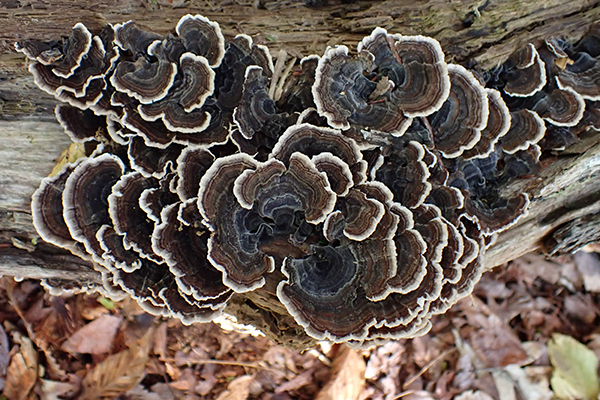
I have recognized the turkey tail (Trametes versicolor) for a while but, as I am learning, there are many other shelf mushrooms that somewhat resemble it.
The upper colors of turkey tail are vibrant. The underside of this specimen was white, distinguishing it other species.
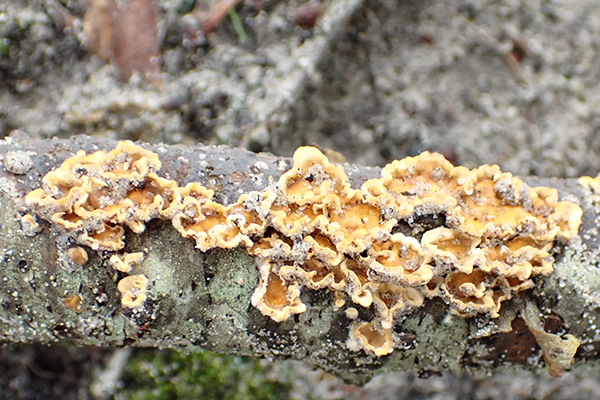
Stereum complicatum offers some welcome coloration. It is widespread in this area. Its common names include "crowded parchment" and "violet curtain crust." It's not clear how those fit with the appearance of the mushroom. I would have said that this specimen is orangish with a pale yellow border. I've seen similar growths that are closer to a violet palette, but I am not sure if they are considered the same species.

I am including jelly fungi here. They do not fit the common notion of "mushroom." Mushroom references deal with them peripherially if at all. Still, they are macrofungi, i.e. of visible size.
This one is the crystal brain, or granular jelly roll (Myxarium nucleatum). It is unusual among land organisms in being transparent, or translucent, as jellyfish are in the sea.
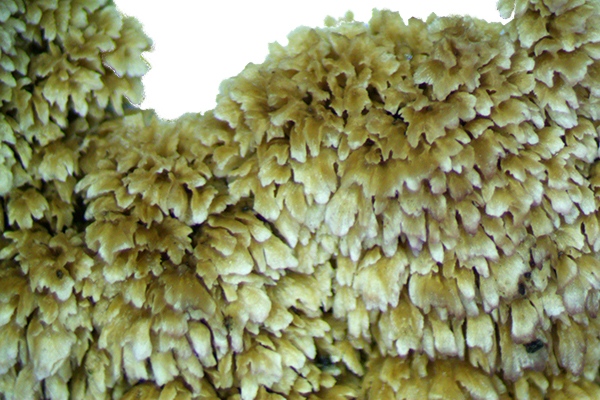
The name of the milk-white toothed polypore (Irpex lacteus) is not far from reality: it is clearly toothed, with tips that are whitish in this view. Sometimes, the whole cluster can be very white.
It is by all accounts, including mine, very common.
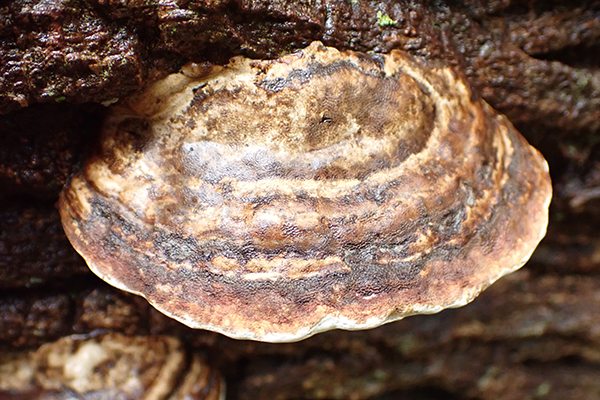
Artist’s conk (Ganoderma applanatum) is an incredibly tough growth. I had quite a bit of difficulty in detaching a specimen to take home. It resisted even woodworking tools in my basement shop.
Wikipedia notes –
A peculiarity of this fungus lies in its use as a drawing medium for artists. When the fresh white pore surface is rubbed or scratched with a sharp implement, dark brown tissue under the pores is revealed, resulting in visible lines and shading that become permanent once the fungus is dried.
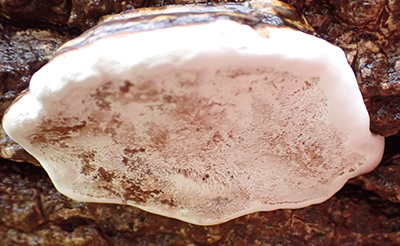
The lower surface, which was a little dirty in this photograph, is very white. The interior mass, once I managed to saw through a section, was very dark.
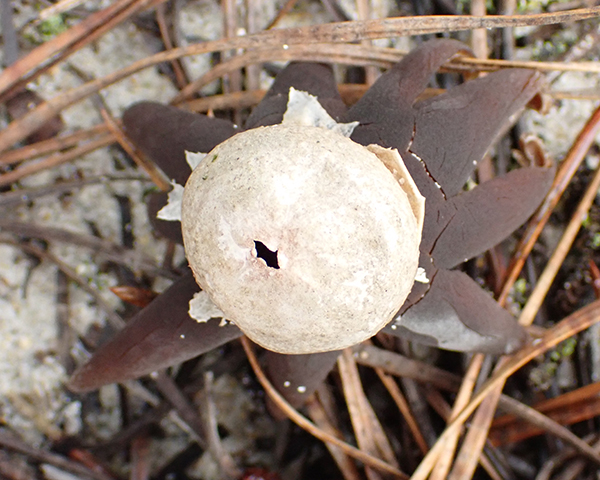
Smith's earthstar (Astraeus smithii) is a relatively new designation, proposed in 2013. Perhaps not all have accepted it; there seems to be more than the usual amount of variability in what names people give to the growths at the Crane Estate.
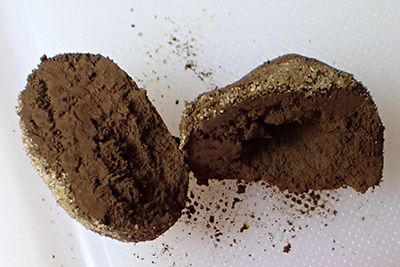
The ripe body has a very small pore hole, which I won't try to show here, to release its spores. They are dark brown at maturity, as is their shell.
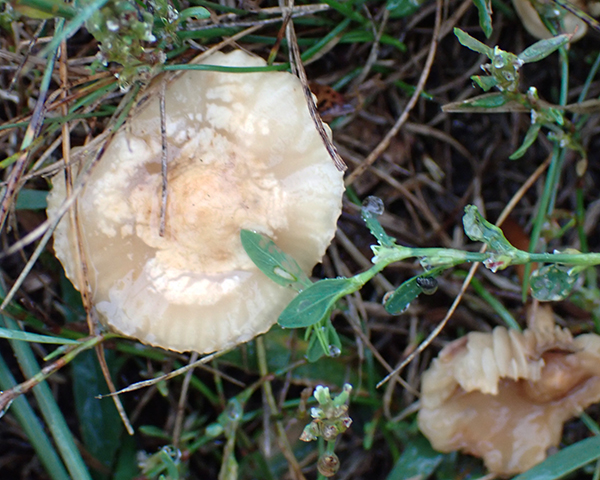
Amid all the rapid evolution in taxonomy in this era of molecular genetics, it is interesting to note that the identify of the fairy ring mushroom (Marasmius oreades) was established in 1836. The name "fairy ring" came, I read, came from the ring-shaped patterns the mushrooms often formed. Google reports –
The name Marasmius comes from the Greek word marasmos (μαρασμός), which means "withering" or "wasting away."
This etymology perfectly describes a unique characteristic of mushrooms in this genus. Unlike most other mushrooms, which rot and decay when they dry out, Marasmius species wither up but do not rot. When it rains again, they can completely revive, absorb moisture, and continue releasing spores. This remarkable survival trait is known as revivescence.
The specimens shown here were part of a handful I noticed in a neighbor's yard after three days of rain. A couple of days later, when the rain had ended and things began to dry up, I could find no trace of them there.
* * *
The lawn habitat is typical. Note the light coloration with a bit of bump in the center. The spore print is white. Bits of the gills are visible in the lower right. They are barely attached to the stem, which is straight and tough.
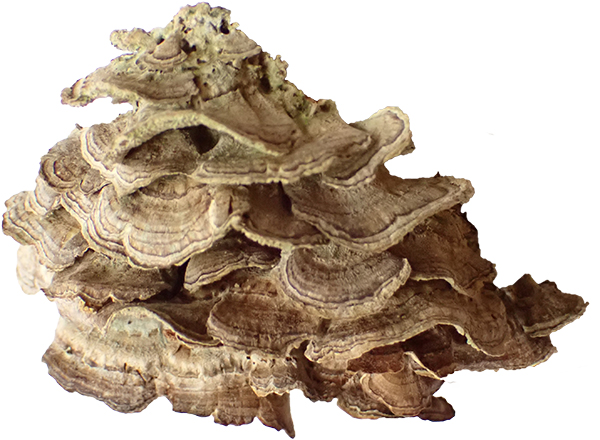
Timothy Baroni cites the violet-toothed polypore (Trichaptum biforme) as "easily the most frequently found species in a hardwood forest because of its aggressive saprotrophic nature to recycle dead, decaying hardwoods." Others agree. So do I. I am very used to seeing it.
* * *
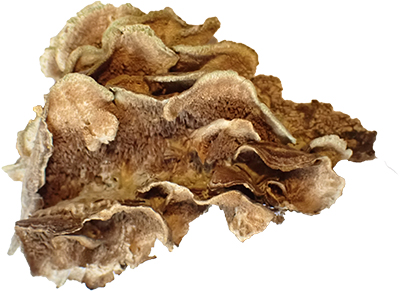
This particular specimen is a bit bedraggled, with a fairly dull color palette. The toothy underside (to the left) perhaps could be described as magenta. MushroomExpert reports the species color as "fading to buff or brownish in age."
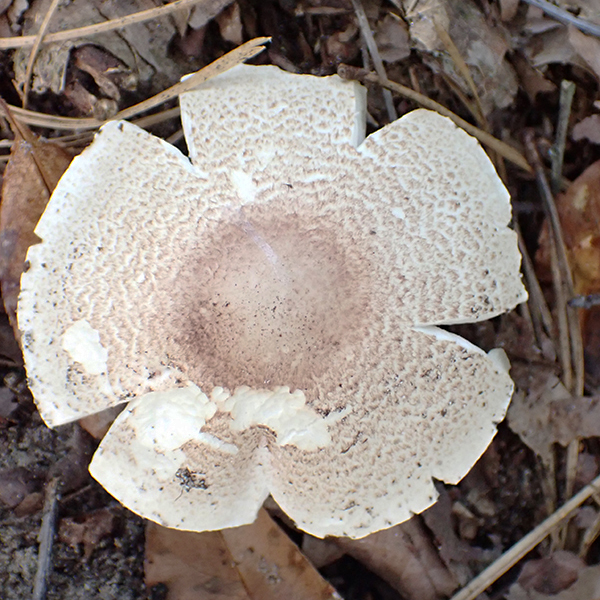
My newly-acquired copy of Baroni's Mushrooms of the Northeastern United States quickly enabled reasonably confident identification of this specimen, which I was struggling with before. Its appearance at a glance is certainly unremarkable. It is, I find, the scaly (or blushing) wood mushroom (Agaricus sylvaticus).
* * *
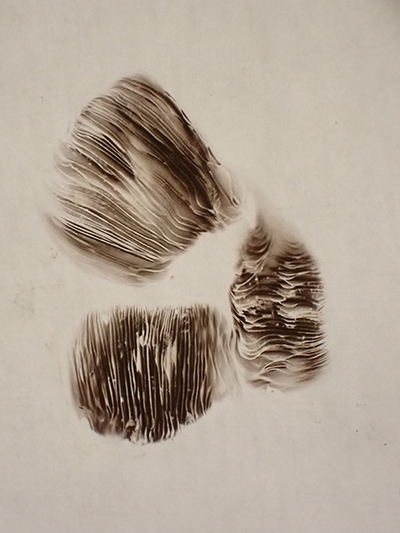
My specimen matches Baroni's notes, in thumbnail: "Cap with contrasting brown scales over white ground color; stem white becoming grayish, with persistent membraneous ring; flesh turning bright red when exposed."
And I am learning to appreciate the ease and value of spore prints, in this case "chocolate or purple-brown," as expected.
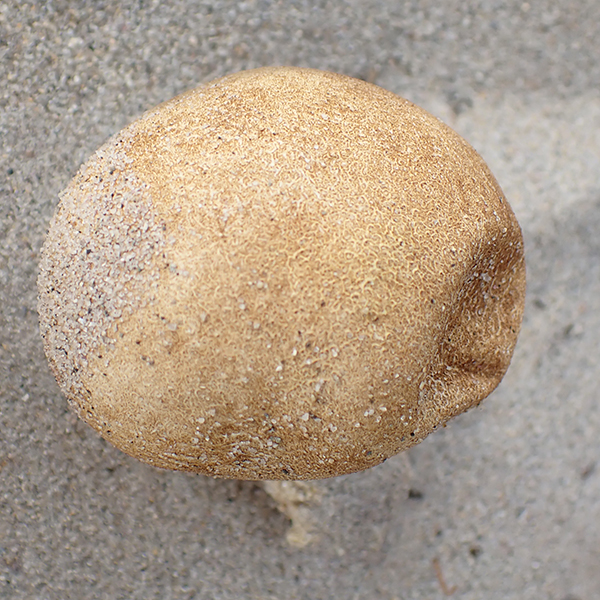
This growth falls into a loose group of "earth ball" mushrooms, so called because they are mostly underground and, like the better known "puffballs," blow out their spores into the air. Specifically, it is Scleroderma septentrionalis = hard-skinned + of the north.
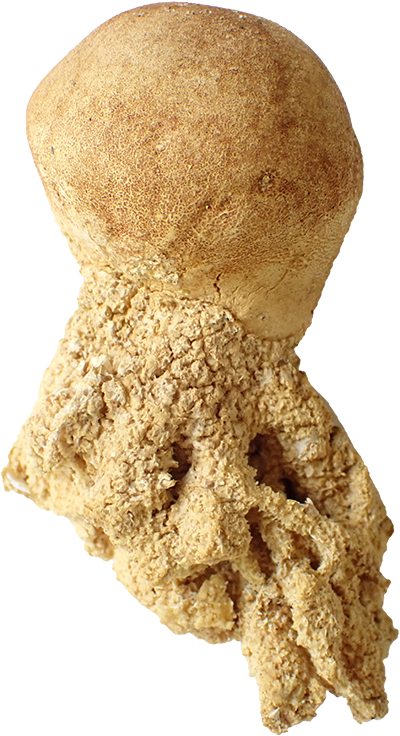
The below-ground portion looks like mutant roots suitable for a witch's brew. Properly speaking, this section is a pseudostipe, actually "a dense collection of whitish rhizomorphs that go deep in the ground to keep it secured in the sandy soil." The species seems to have an affinity with pines; or perhaps the taxa are simply among the few that can survive in such nutrient-poor habitats.
I find it interesting that S. septentrionale, like the "reindeer lichen," Cladonia rangifera, is found especially in sand dunes of this area and in Finland. Surely that is more than a coincidence – but how did it happen?
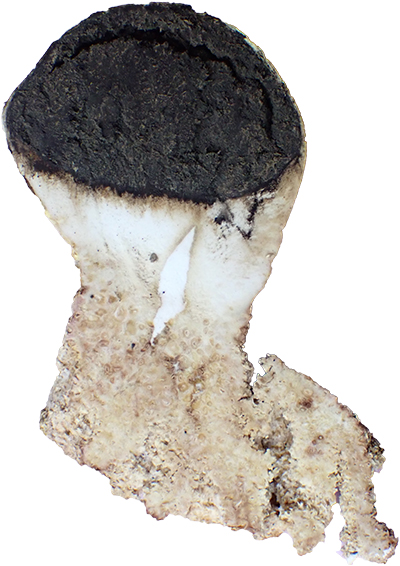
The dark interior spore section of the fungus is visible in a sliced view.
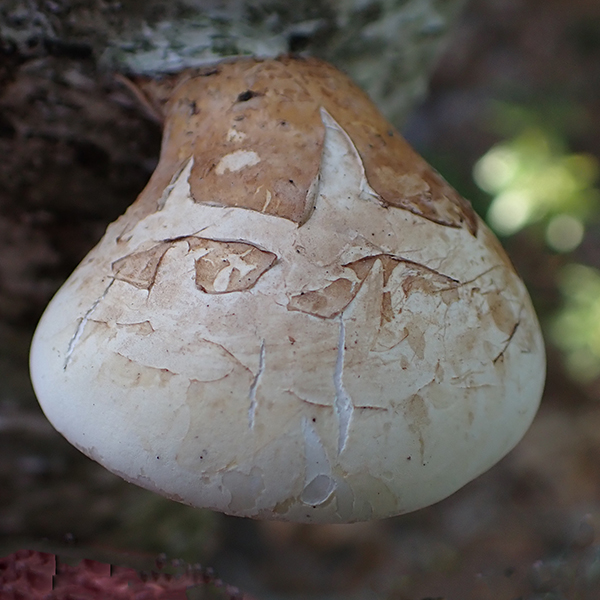
Fortune continued to smile on me in the identification of my second mushroom specimen. It is the birch polypore (Fomitopsis betulina). Being very well-behaved and trying to live up to its name, it grew on a birch tree. And I had learned early in browsing through the guides that many common tree-trunk growths were called polypores = Greek πολυ (many) + pores, which they have rather than gills for dispersing their spores.
The only wrinkle is that with modern molecular genetics, genus and higher groupings are being rearranged, so that Polysporus betulinus became Piptoporus betulinus and then Fomitopsis betulina, while the species-level identity remained stable. Such nomenclature adjustments among fungi are common.
* * *
MushroomExpert notes, "Anyone who has spent time in birch woods has seen Fomitopsis betulina on dead birch trees and logs, or occasionally on still-living trees. The species is an attractive polypore, easily recognized by its habitat on birch wood and the fact that the cap folds over to make a distinctive, smooth rim around the pore surface."
The normal cap diameter is 5–25 cm across and 4–10 cm deep. This specimen measures out at 25 cm across and 15 cm deep. Upon slicing, its flesh is white and firm, as expected.
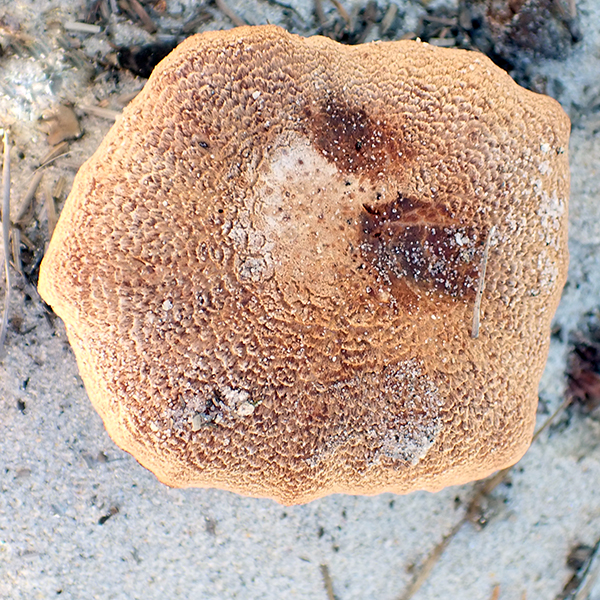
I have had beginner's luck in identifying the first specimen I gathered. Initially, it appeared quite nondescript: a pale brown growth that fit the typical size and cartoon shape for "mushroom."
Its habitat in sand, however, was unusual. Most often, mushrooms grow on or very close to their nutritive sources; they are not solitary desert organisms. The distinctive home enabled ready identification via a Google AI search for "mushrooms in sand in coastal Massachusetts." A few minutes' further research confirmed the taxon as Laccaria trullisata (perhaps more correctly spelled as trullissata).
* * *
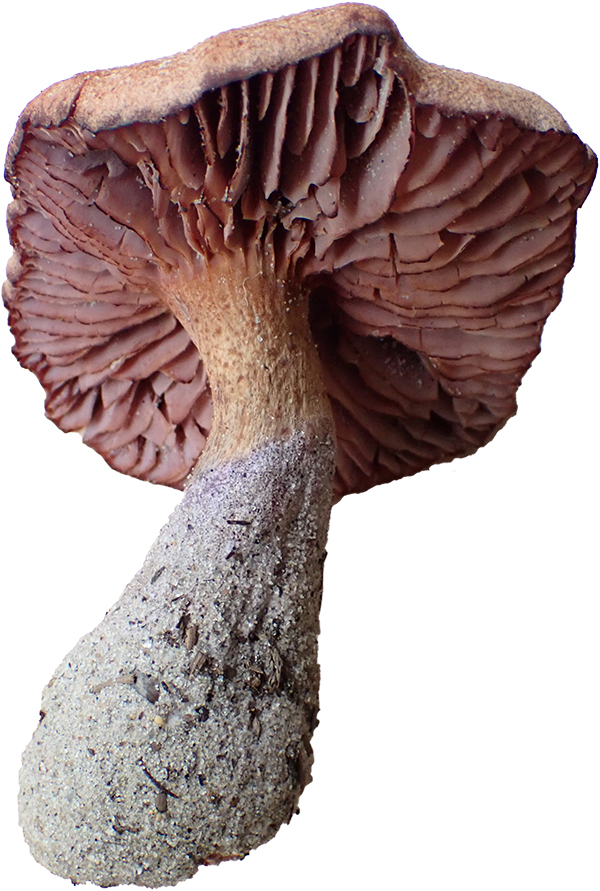
Michael Kuo's MushroomExpert offers useful notes: "This interesting species of Laccaria can be found in sand dunes on the East Coast, the Gulf Coast, and along the Great Lakes. Its habitat and its thick, purple gills distinguish it from just about anything else"
Alphabetical by scientific name
© 2026 Paul Nordberg